This part of the course is designed to give you a clear understanding of what we will focus on during our study together. At the beginning, we will look at the basic structure of the course, its main goals, and the knowledge and skills you are expected to develop.
We will deal with the key topics step by step, starting from the fundamental concepts and gradually moving toward more practical examples and deeper understanding. The aim is not only to provide theoretical knowledge, but also to help you connect it with real situations, discussions, and tasks.
Throughout the course, you will be expected to participate actively, think critically, ask questions, and apply what you learn. We will also discuss how your progress will be assessed, what is required for successful completion, and how you can prepare for classes, assignments, and exams.
By the end of this course, you should have a solid overview of the subject, understand its importance, and be able to use the acquired knowledge in further study or practice.
- Teacher: Monika Hudakova
This course offers an in-depth exploration of the cultural heritage of the Jiangnan region in China, covering both tangible and intangible aspects. Through the study of this course, students will develop a comprehensive understanding of the cultural heritage of Jiangnan, including its historical significance, artistic value, and cultural appeal. They will learn to present, analyze, and critically discuss the unique features of Jiangnan’s cultural heritage and gain insights into traditional cultures by comparing and contrasting those of Slovakia and China. They will cultivate the ability to critically engage with cultural and heritage-related topics, fostering a deeper appreciation for cultural diversity. And they will also develop a scientific perspective on world heritage conservation, emphasizing the importance of preserving cultural heritage for future generations. By the end of the course, students will not only have a profound appreciation for the poetic charm and rich cultural allure of Jiangnan but will also have enhanced their cross-cultural competence, preparing them to engage meaningfully with diverse cultural contexts.
- Teacher: Haitao Zhao
It is a Chinese learning and teaching course, which aims to enable the local students to acquire basic Chinese linguistic competence as well as the visiting Chinese students to practice their Chinese teaching skills in the international context. Therefore, the teacher is really a facilitator in the course: he is going to build a platform throughout the course to facilitate: on the one hand, local students to learn Chinese from visiting Chinese students and teacher; on the other hand, Chinese students to practice their “teaching Chinese as a foreign language” skills in the real international setting. And the final evaluation will be based on: for Chinese students, how well they have practiced their language teaching skills and the effect of their teaching—how well the local students have acquired the linguistic competence prescribed in the course goal—the latter is also the major evaluation indicator for the local students (through oral tests, group conversations or demonstration activities).
- Teacher: Zhongguang Dai

This is a distinctive course dedicated to China's logistics industry and its enterprises. It aims to help students gain a deep understanding of the development history, operation mode, current status and future trends of China's logistics enterprises, enhance their professional qualities and practical abilities, and master the knowledge and skills in operation management, strategic planning, technological innovation and other aspects of logistics enterprises. Lay a solid foundation for future work related to logistics. The final evaluation basis is: completing the relevant projects of logistics enterprises in a group form and conducting classroom presentations to assess teamwork and communication skills.
- Teacher: Zongtuan Liu
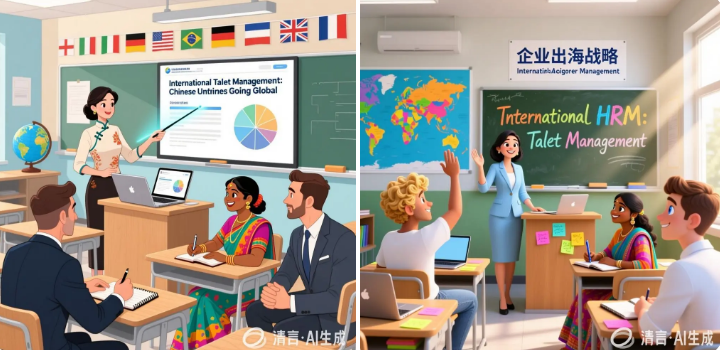
Rooted in the globalized context, this interdisciplinary course centers on International Human Resource Management (IHRM). Starting with the fundamental concepts of human resource management, it uses real cases of Chinese corporations’ global expansion to help the students gain a clear understanding of the current status of overseas expansion and talent demands of these enterprises. Through case-based teaching, the course will break down the real challenges and solutions faced by authentic Chinese firms in cross-regional talent planning, international recruitment, cross-cultural training, overseas performance management, and international compensation design. Meanwhile, by integrating Chinese local culture, this course will also help the students enhance their cross-cultural competence and professional skills, thereby improving the students’ professional competitiveness in future international career development.
- Teacher: Liguo Wu